The Home Cleaning Schedule That Actually Works for Working Parents
A weekly cleaning routine that survives soccer practice, late meetings, and a stomach bug. Built for working parents who don't have Sundays to deep clean.
You don't have a cleaning problem. You have a schedule problem dressed up like a cleaning problem.
The house isn't filthy because you're lazy. It's filthy because every cleaning plan you've ever tried was written by someone who assumed you had a free Saturday morning and a partner who naturally noticed when the trash was full. You don't have a free Saturday morning. You have a 7:15am dropoff, a 9am standup, a 4pm soccer pickup, a dinner that needs to be on the table by 6, and a kid who just spilled apple juice on the couch you cleaned yesterday.
The cleaning schedule that actually works for working parents looks nothing like the Pinterest version. It's smaller, meaner, more honest about how much time you actually have, and it doesn't punish you on the weeks when life eats your plan whole.
Here's how to build one.
Stop trying to clean the whole house in one block
The number-one reason cleaning schedules fail for working parents is the "Saturday morning blitz" model. You decide that every Saturday from 9 to 12 is The Cleaning Window. Then someone gets a fever, or there's a birthday party, or you're just genuinely exhausted from a 60-hour work week, and the whole house slides for two weeks.
The fix is to break the house into a daily rotation that takes 15 to 25 minutes a day, max. Not 90 minutes once a week, fifteen minutes, six days a week. The math is the same. The sustainability is not.
A working version of the rotation looks like this:
- Monday, bathrooms (the two you actually use, not all four)
- Tuesday, kitchen deep (under the toaster, the stove drip pans, the inside of the microwave)
- Wednesday, floors (vacuum the high-traffic rooms, mop where it matters)
- Thursday, laundry catch-up + bedrooms (sheets, surfaces, the pile on the chair)
- Friday, living areas and entryway (dust, wipe, reset)
- Saturday, one rotating "deep" task (fridge, oven, baseboards, windows, pick one)
- Sunday, off, or a 10-minute reset before the week starts
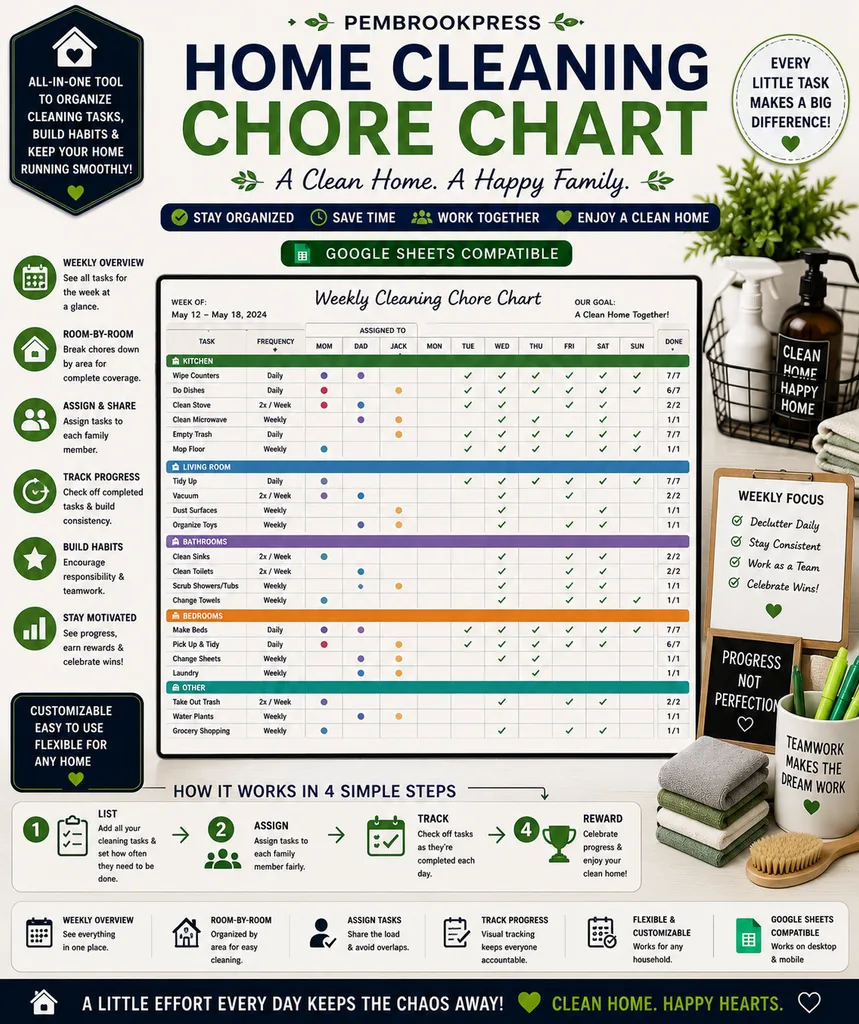
The Home Cleaning Schedule & Chore Chart lays this out as a printable rotation you can stick on the fridge. The reason it works isn't the layout, it's that the daily task is small enough that you'll actually do it after dinner, even on a hard day. Anyone can find 15 minutes. Almost no one can find 90.
Build a "minimum viable house" definition
This is the move that changes everything. Sit down with your partner, or yourself, if you're solo-parenting, and define what "clean enough" means for your family. Not aspirational. Not Instagram. The floor.
For most working families, the minimum viable house looks like:
- Kitchen counters clear and wiped before bed
- Dishwasher run every night, emptied every morning
- One load of laundry started in the morning, moved to the dryer at lunch, folded after kid bedtime
- Bathrooms wiped (not scrubbed) once a week
- Floors vacuumed in the rooms you live in once a week
- Trash and recycling out on collection day, no negotiating
That's it. That's the baseline. Everything above that, the deep clean, the closet purge, the garage, is bonus, scheduled separately, not part of the weekly rhythm.
The reason this matters: when you have a defined floor, you can hit "good enough" in 20 minutes and stop feeling like the house is winning. The endless cleaning shame loop comes from chasing an undefined target. Define the target and the loop breaks.
Stop being the only one who notices
The second-biggest reason cleaning schedules fail is that one parent, usually but not always the mom, is carrying the entire mental load of the house. They notice the toilet paper is out. They notice the dog needs a bath. They notice the milk expires Friday. They notice the kid grew out of last winter's snow boots. The other parent helps when asked, but the asking is itself a full-time job.
The cleaning schedule has to be visible, shared, and owned by both adults, and ideally the kids old enough to push a broom. Not because chores build character, though they do. Because if only one person sees the system, only one person feels responsible for it, and that person eventually burns out and resents the rest of the household.
The Family Manager Household Operations toolkit handles this directly. It centralizes the household runbook, who does what, when, how often, so the cleaning schedule isn't a private mental list living in one parent's head. Stick a printed version on the inside of a cabinet door. Sunday night, the family glances at the week. Tasks are assigned. Nobody is the unpaid project manager anymore.
A practical assignment split that works for most two-parent households:
- One parent owns the kitchen and food cycle
- The other owns laundry and bathrooms
- Kids 6+ own their own room, the trash empty, and the table set/clear
- Floors and weekly deep tasks rotate
- The "remember the small stuff" load, refills, replacements, appointments, rotates monthly
Whatever split you pick, write it down. Verbal agreements about housework evaporate the moment a deadline hits.
Use the small windows. Stop saving cleaning for "later."
The most underused asset working parents have isn't Saturday morning. It's the 47 ten-minute pockets that show up in a normal week and get burned on phone scrolling. Waiting for the kid's piano lesson to end. The fifteen minutes after dinner before bath time. The eight minutes the toddler is happily eating Cheerios. The conference call where your camera is off.
Here's what fits in 10 minutes:
- Empty and reload the dishwasher
- Wipe down a bathroom sink and toilet
- Throw a load of laundry in
- Sweep the kitchen floor
- Clean out one drawer
- Strip and remake a bed
- Wipe every doorknob and light switch in the house
If you do three of these in a normal weekday, the weekend doesn't have to be a battlefield. The trick is to stop seeing cleaning as a block and start seeing it as a rhythm you slip into the cracks.
The Cleaning Schedule printable is built around this, it lists daily, weekly, monthly, and seasonal tasks broken down small enough that you can grab one when a window opens. No more standing in the kitchen at 9pm thinking "I should clean something" and then doing nothing because you don't know where to start.
Plan for the weeks that fall apart
Every working parent has bad weeks. The stomach bug week. The work-trip week. The newborn week. The week the babysitter quits. Your cleaning schedule has to assume these weeks will happen and have a fallback, or one bad week becomes a permanent slide.
The fallback is a "triage mode" version of your schedule. Three rules:
- Kitchen counters get cleared every night. Even if dishes go in the sink. Even if it's at 11pm. A cleared counter in the morning is the difference between feeling like you're surviving and feeling like you're drowning.
- One load of laundry moves forward every day. Wash, dry, or fold, pick one. Don't try for all three.
- The bathroom you and the kids actually use gets a 60-second wipe every other day. Pre-wet wipes under the sink. Counter, faucet, toilet seat. Done.
That's triage mode. Skip everything else. When normal life returns, you reboot the full schedule on a Monday. You don't try to catch up. You don't deep clean the whole house in penance. You just start the rotation again where it would have been.
This is the part that takes the guilt out of the system. A schedule that has a graceful degradation mode is a schedule you'll stick with for years. A schedule that breaks the first time life happens is one you'll abandon by March.
Add the dog. Add the kids. Add real life.
A cleaning schedule for a working family with kids isn't the same as a cleaning schedule for a single person in a studio. There's a dog hair layer. There's a snack debris layer. There's a sticker-and-craft-supply layer. The schedule has to account for all of it or it's just a fantasy of someone else's house.
If you've got a dog, the floors are a different game, daily quick vacuum in the high-traffic path, weekly deeper run, monthly base trim around the furniture. The Dog Mom Planner bakes the dog-care rhythm into the household schedule (grooming, vet, feeding, walking) so the animal isn't a separate mental list living in your head on top of everything else.
If you've got kids old enough to help, assign them daily zones that match their age. A four-year-old can put their shoes by the door and bring their plate to the sink. A seven-year-old can wipe their own bathroom counter. A ten-year-old can run a load of their own laundry start to finish. Build the chore into the routine, not into a battle.
Start this week
Don't try to launch a perfect system on day one. Pick the rotation, print the schedule, put it on the fridge, and do Monday's task tonight. That's all.
The Home Cleaning Schedule & Chore Chart gets you most of the way there in an evening, daily, weekly, monthly tasks, broken down by room, plus a chore chart kids can actually see. Pair it with the Family Manager Household Operations toolkit when you're ready to stop being the only person who notices what the house needs.
The house won't get cleaner because you tried harder. It'll get cleaner because the system finally fits the life you actually live.
Home Cleaning Schedule Chore Chart
Daily resets, weekly rotations, deep-clean checklists by room, and a supply restock log, the whole house. Sequenced.