How to Plan the Holidays Without Losing the Entire Month of December
Stop spending $1,400 on gifts you didn't track, hosting on three hours of sleep, and arriving at January exhausted. A holiday planning system that actually works.
You don't have a December problem. You have a November planning problem you didn't solve, which is now eating December alive.
Every year it's the same arc. November feels manageable. The first week of December still feels okay. By the second week, you're behind on gifts. By the third week, you're shopping at 11pm on your phone in bed, spending $40 more per person than you meant to because shipping deadlines are closing in. By Christmas Eve, you've spent $1,400 you didn't budget for, hosted two events on six hours of sleep, missed your kid's school party because of a work deadline, and arrived at January resentful and broke. Then you say "next year will be different" and don't change a single thing.
Next year is different when you build the system in October and run it on autopilot. Here's how to actually plan the holidays without losing December.
Start in October. Yes, October.
The single most common mistake people make with holiday planning is starting too late. They think the holidays start Thanksgiving week. The holidays actually start the day you sit down with a budget and a list, and if that day is November 28, you've already lost.
The reason October matters: by mid-November, the good gift items are out of stock or on a three-week shipping delay, the calendar fills up with school events and work parties, and you no longer have the bandwidth to think clearly about what you actually want the month to feel like. Decisions made under time pressure cost more, in dollars, in stress, in disappointment.
Your October planning session is 90 minutes, once. You do it with coffee or a glass of wine, ideally with your partner. You answer four questions:
- What's the total budget? All-in, including gifts, food, travel, hosting, decor, photos, charitable giving, teacher gifts, the works.
- Who are we giving to? Every name. Family, kids' teachers, the mail carrier if you do that, your team at work, the babysitter, the friend group exchange.
- What are we hosting or attending? Every event we know about, every event we expect to add.
- What do we actually want December to feel like? Slow? Festive? Quiet? Big? You can't design a season if you can't describe it.
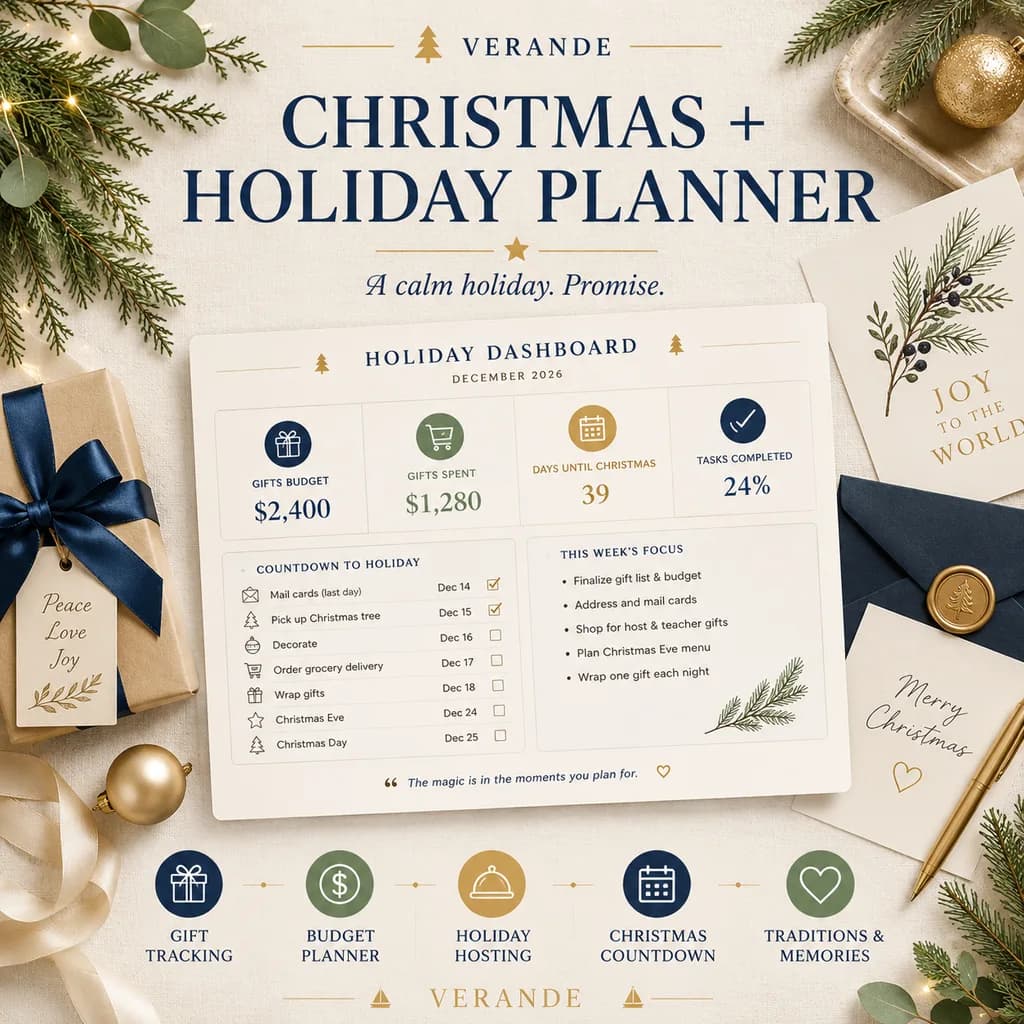
The Christmas & Holiday Planner gives you a structured place to do this, gift list, event calendar, menu planner, budget dashboard, all in one view. Sitting down once in October with this and a partner does more for your December than anything you'll do in November.
Set the gift budget per person, then add it up, not the other way around
The biggest financial mistake people make at the holidays is setting a total gift budget ("we'll spend $800 on Christmas") and then trying to spread it across the list. It never works. By the time you get to person twelve, you've either blown the budget or you're spending $15 on your sister because you went too hard on the kids.
Do it the other way. List every recipient. Set a per-person amount based on what feels right for that relationship. Sum it up. That's your real number.
The first time you do this, the sum is going to be 40 to 80 percent higher than what you would have set as a top-down budget. That's the truth your finances have been hiding from you. Now you can make real decisions:
- Cut three people from the list (or move them to a card-and-handwritten-note tier)
- Lower the per-person budget for the wider circle (cousins, work team, neighbors)
- Group gifts, one nice gift for the whole family of four instead of four mediocre ones
- Move to homemade or handwritten for the relationships where money was a substitute for thought anyway
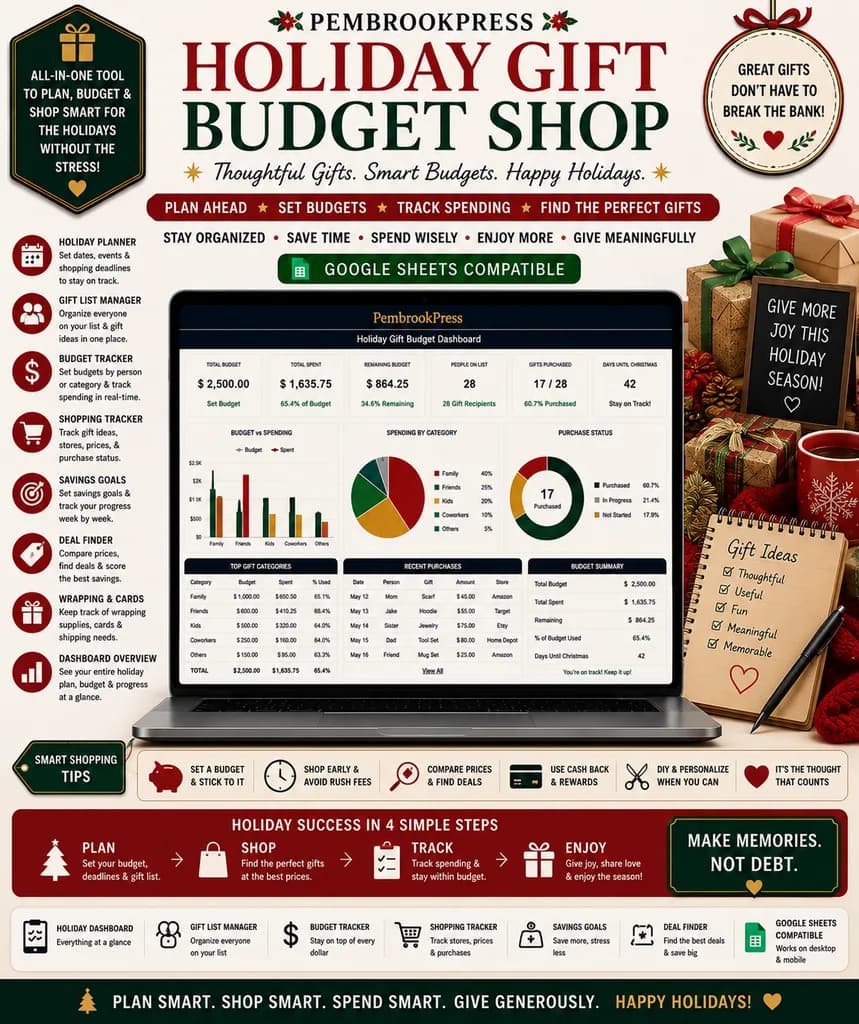
The Holiday Gift Budget & Shopping Planner is built around this exact workflow, every recipient, per-person budget, what you've bought, what you've spent, what's left to find. People who use it routinely spend 20 to 30 percent less than they did the year before, not because they cheaped out but because the spending finally matched the intent. You stop the panic buys. You stop the "I forgot to get her something, throw a $60 candle in the cart" moves.
Build the gift list off real wishlists, not your guesses
The second-biggest reason holiday spending balloons is that people guess what others want, guess wrong, and then either spend more trying to fix it ("she didn't love the necklace, let me grab her a sweater too") or end up giving gifts that nobody actually uses. The fix is to operate from a real wishlist, not a wish-list-in-your-head.
For your immediate family, run a wishlist exchange in early November. Each person, including kids old enough, adds 5 to 10 items at a range of price points, with links. Nobody is required to use the list, but everyone has it as a reference. Aunt Linda asking "what does your son actually want this year" has an answer, instead of a guess that becomes another robot dinosaur he won't touch.
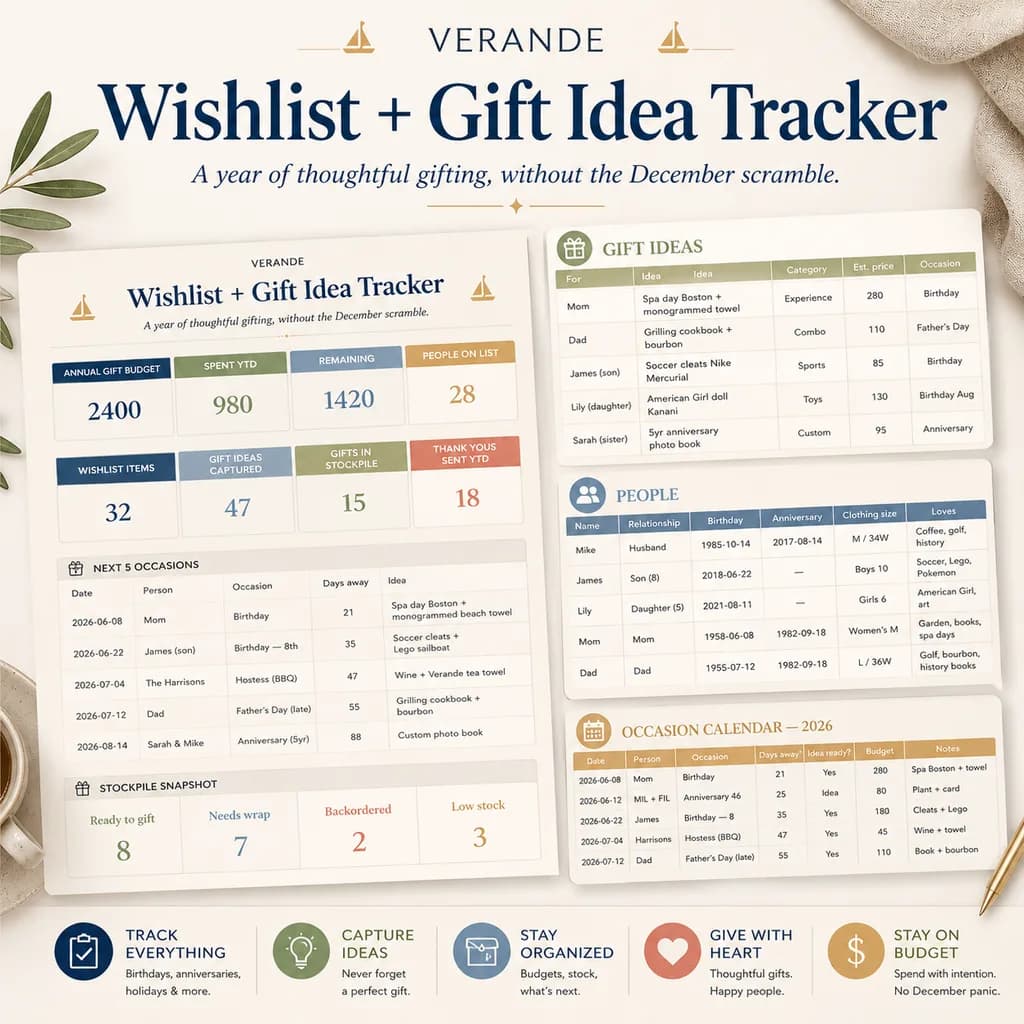
The Wishlist Gift Tracker handles the running list, what each person wants, who's getting what (so two relatives don't buy the same gift), price tracking, where to buy, gift-received log. Used well, it kills the duplicate gift problem and the awkward returns. It also doubles as a year-round wishlist for birthdays, anniversaries, and the random "we should send something to grandma" moments.
For the wider list, extended family, coworkers, neighbors, you don't need wishlists. You need defaults. Pick one or two go-to gifts at the right price point, in bulk. Twelve nice candles. Eight boxes of locally-made chocolates. Six bottles of the wine you give every year. Buying twelve of one good thing is 70 percent cheaper than buying twelve different things, and recipients don't compare notes anyway.
Plan the calendar before December owns it
By the second week of December, your calendar will look like a Tetris game you're losing. School concerts, work parties, neighborhood gatherings, family events, gift exchanges, the kids' performances, three different friend dinners, church, travel days, the in-laws arriving. If you don't pre-design what you're saying yes and no to, you'll default to yes for everything and burn out by week three.
The November calendar exercise:
- List every event you know about and every event you expect to be invited to
- Mark the non-negotiables (kid's concert, family Christmas, the work thing your boss is watching)
- Mark the would-be-nice (the friend group party, the cookie exchange, the optional church service)
- Mark the obligation-only (the office party you dread, the third cousin's open house)
- Pre-decide which would-be-nice events you'll attend and which you'll send regrets to. Pre-decide your exit strategy for the obligation-only ones, arrive late, leave early, one drink and out.
This is the unglamorous secret of people who actually enjoy December: they say no to about a third of what they're invited to, on purpose, decided in advance. The yes pile becomes meaningful. The no pile stops being a source of guilt.
The Christmas & Holiday Planner has the calendar view built in, every event, every date, every host-vs-attend designation, plus the prep tasks that lead up to each one (the cookies you said you'd bring, the white elephant gift, the wrapped book for the swap). You stop showing up empty-handed because you forgot. You stop showing up at all to the events you didn't actually want to attend.
If you're hosting, build the menu and timeline weeks out
Hosting is where the holidays go from "fun and meaningful" to "I cried in the pantry at 4pm." Not because hosting is hard, because you tried to plan the menu, shop, prep, cook, set, and serve all in 36 hours.
A real hosting timeline starts 14 days before the event. Menu locked. Grocery list separated into "buy now," "buy three days out," and "buy day of." Cooking schedule mapped backward from serving time, what gets prepped two days ahead, what's morning-of, what's the last 90 minutes. Table settings, serveware, drinks, music, all decided before the week starts.
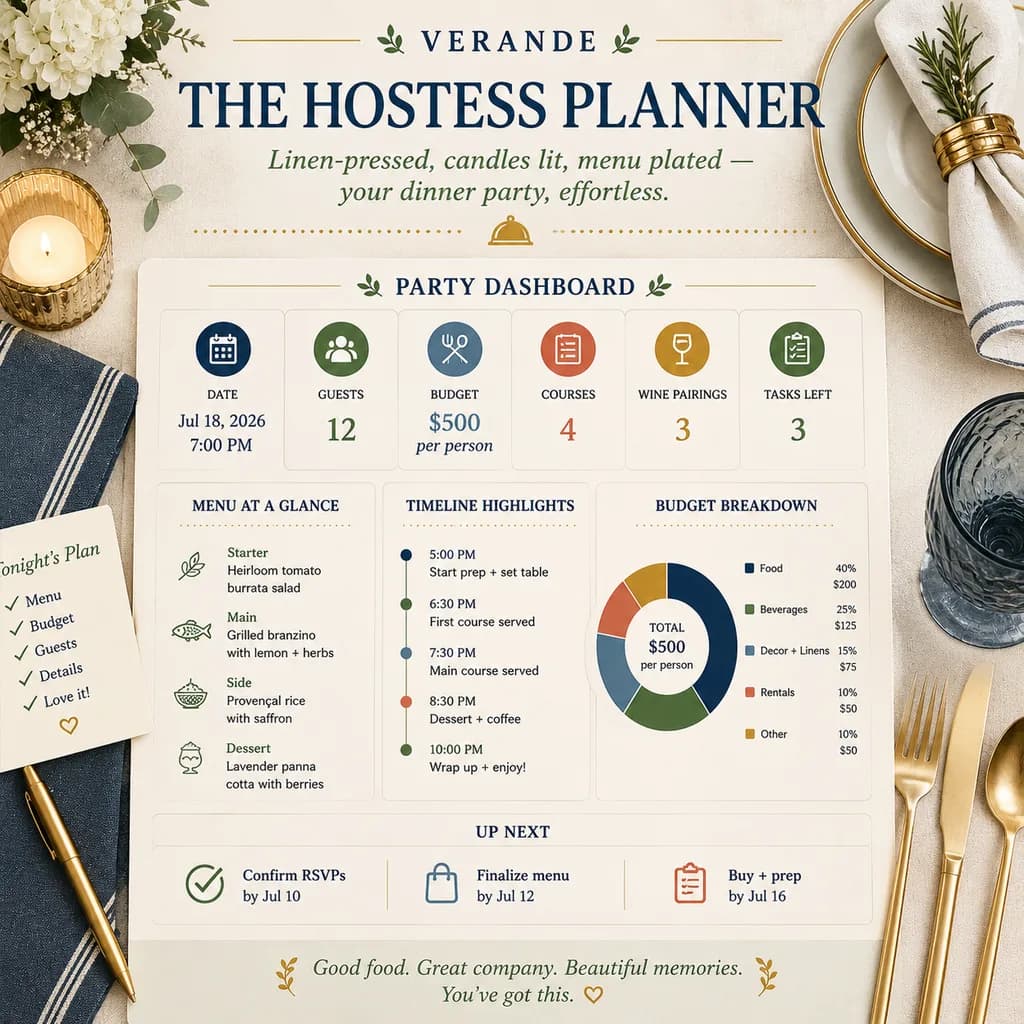
The Hostess Dinner Party Planner walks you through the whole arc, guest list and dietary notes, menu and timeline, shopping in chunks, prep schedule, day-of timing, even a "what went well, what to change" debrief so next year is easier than this year. Hosting becomes a project you executed, not a panic you survived.
A few hosting moves that quietly save the day:
- Pick one showstopper, everything else is easy. One impressive dish carries the whole meal. The rest can be sides that take 12 minutes.
- Cook one thing the day before. Soup, braise, dessert, cranberry sauce. Anything you can finish 24 hours out is 24 hours of pressure you've removed from the actual day.
- Set the table the night before. It takes 15 minutes the night before. It takes 15 stress-units the day of.
- Outsource one thing without guilt. Buy the dessert. Buy the bread. Buy the pre-cut vegetables. Nobody has ever, in the history of dinner parties, complained that the host didn't bake the pie from scratch.
Build in a real recovery window
The last move, the one almost nobody does: block recovery time into your calendar before the season starts. The 26th and 27th of December are non-negotiable downtime in your house. Pajamas. Leftovers. No events. No travel. No social obligations. This is the time your nervous system uses to process the previous five weeks. If you skip it, January arrives and you're cooked.
Same for early January. Don't book the first week of January with "fresh start" projects. Use it to recover, file the receipts, put the decorations away, and quietly review what worked and what didn't so next October's planning session has data instead of vibes.
Start in October, finish by mid-December
The whole point of this system is that by December 15, your gifts are bought and wrapped, your menu is locked, your calendar is decided, and you can actually enjoy the last ten days instead of dragging yourself through them.
The Christmas & Holiday Planner is your central spine, gift list, calendar, menu, budget, all in one place. The Holiday Gift Budget & Shopping Planner is the financial control layer that keeps the spending honest. The Wishlist Gift Tracker feeds it real data instead of guesses. And the Hostess Dinner Party Planner is what turns the events from panic into pleasure.
You can't get the magic of December back if you spend the whole month surviving it. The system is what gives you back the month.
Christmas Holiday Planner
Gift list with budget, card mailing list, hosting plan, holiday menu, and a decor checklist. December, managed in advance.