How to Actually Get in Shape This Year (and Track It Like You Mean It)
A fitness tracker spreadsheet beats apps, fitness gurus, and motivational quotes. Here's how to build a workout log you'll still be using in November.
You don't need a new workout. You need a system that survives week six.
Everyone who's ever tried to get in shape has the same arc. The first two weeks are magic, every workout is a victory, the scale moves, you tell people about it. Weeks three and four are still solid. Week five is when life gets in the way once. Week six is when life gets in the way twice. By week seven, you've missed four workouts, the streak is dead, and the program is "on pause", which is the polite word for over.
The people who actually get in shape aren't more disciplined. They're not genetically gifted. They have a tracking system that absorbs the misses without breaking, gives them honest data instead of vibes, and pulls them forward when motivation runs out. Apps don't do this well. Fitness influencers definitely don't. A simple spreadsheet does.
Here's how to build the tracking system that actually gets you to the goal.
Pick one metric that actually matters. Not five.
The first failure mode is metric overload. You decide to track weight, body fat, waist measurement, workout count, calories in, calories out, steps, sleep, water intake, mood, and protein grams. By day six you're spending more time logging than training. By day fourteen you've quit.
A real tracking system has one primary metric, the thing that, if it moves in the right direction, the program is working. Everything else is supporting data, optional, nice-to-have.
How to pick your primary:
- If your goal is fat loss, the primary is body weight, measured daily, averaged weekly. Daily because the noise is enormous and you need the average to see signal. Weekly average is what you actually look at.
- If your goal is strength, the primary is total weight moved per session in your main lifts. Bench, squat, deadlift, overhead press, sum the sets x reps x weight, watch the number trend up week over week.
- If your goal is endurance, the primary is weekly mileage (or weekly minutes of zone 2 cardio). Volume is the lever. Volume gets tracked.
- If your goal is general health / habit, the primary is workout adherence, sessions completed per week, against a target.
Pick one. Track it religiously. Track everything else loosely or not at all. A system that asks for less is a system you'll use.
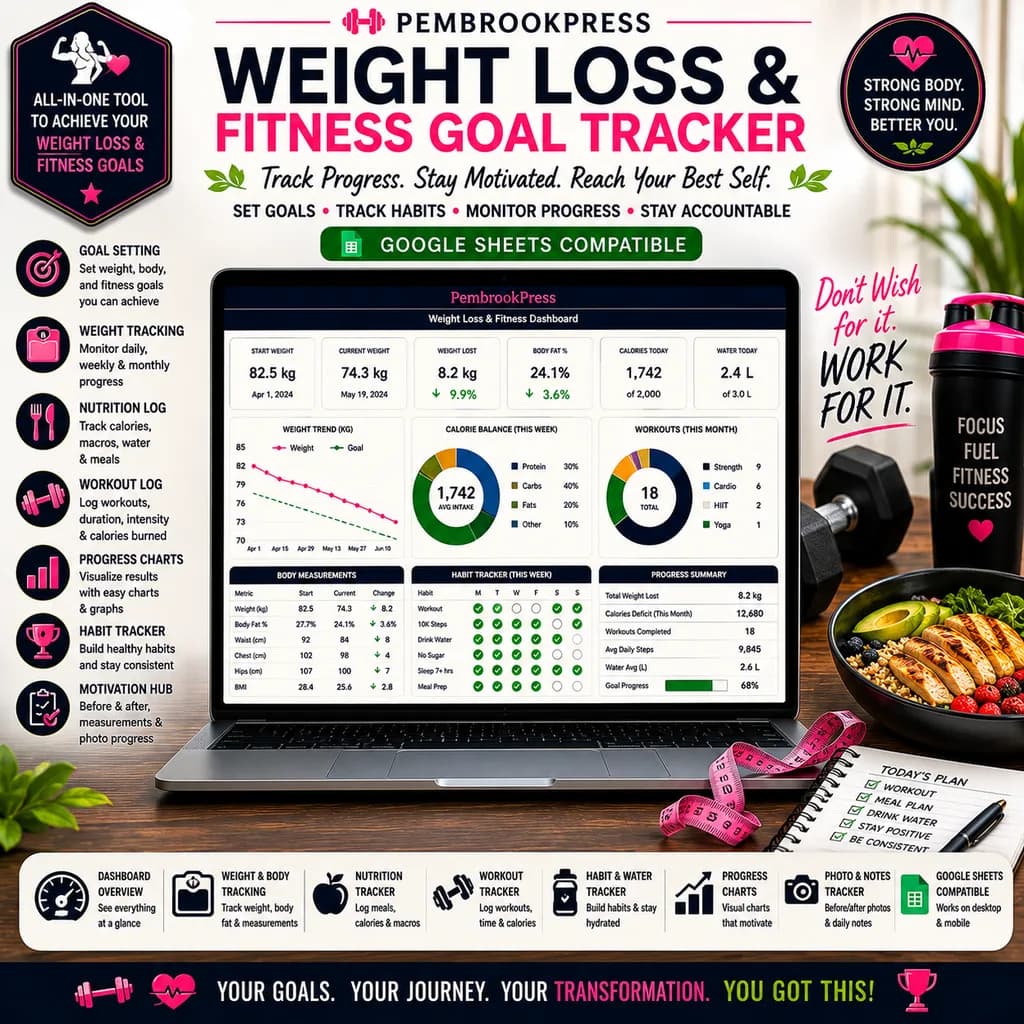
The Weight Loss & Fitness Goal Tracker is built around this single-metric-primary model, pick your goal, the dashboard shows your primary trend front and center, with secondary metrics tucked into supporting tabs. The visual feedback loop is the point. People who watch a weekly weight average for 12 weeks are dramatically more likely to hit a fat-loss goal than people who weigh themselves every Monday and panic.
Log the workout, not the feelings
The second failure mode is reflective logging. You finish a workout, open an app, and try to write a journal entry about how it felt. By week three this is exhausting and you stop.
A workout log is for data, not narrative. Three fields per session is enough:
- Date and workout name ("Monday push" or "5-mile run")
- What you actually did, the lifts and weights/reps, or the distance and pace
- One number that tells you the trend, top set weight, total volume, average pace, time to complete
Optional fields: how hard it felt (RPE 1-10), one note ("right shoulder twinge" or "great energy"). That's the ceiling. Anything more is overhead.
The point of the log isn't to remember the workout. It's to give you data about whether you're getting stronger, faster, or fitter, and to make next week's session non-negotiable because there's a number you have to beat.
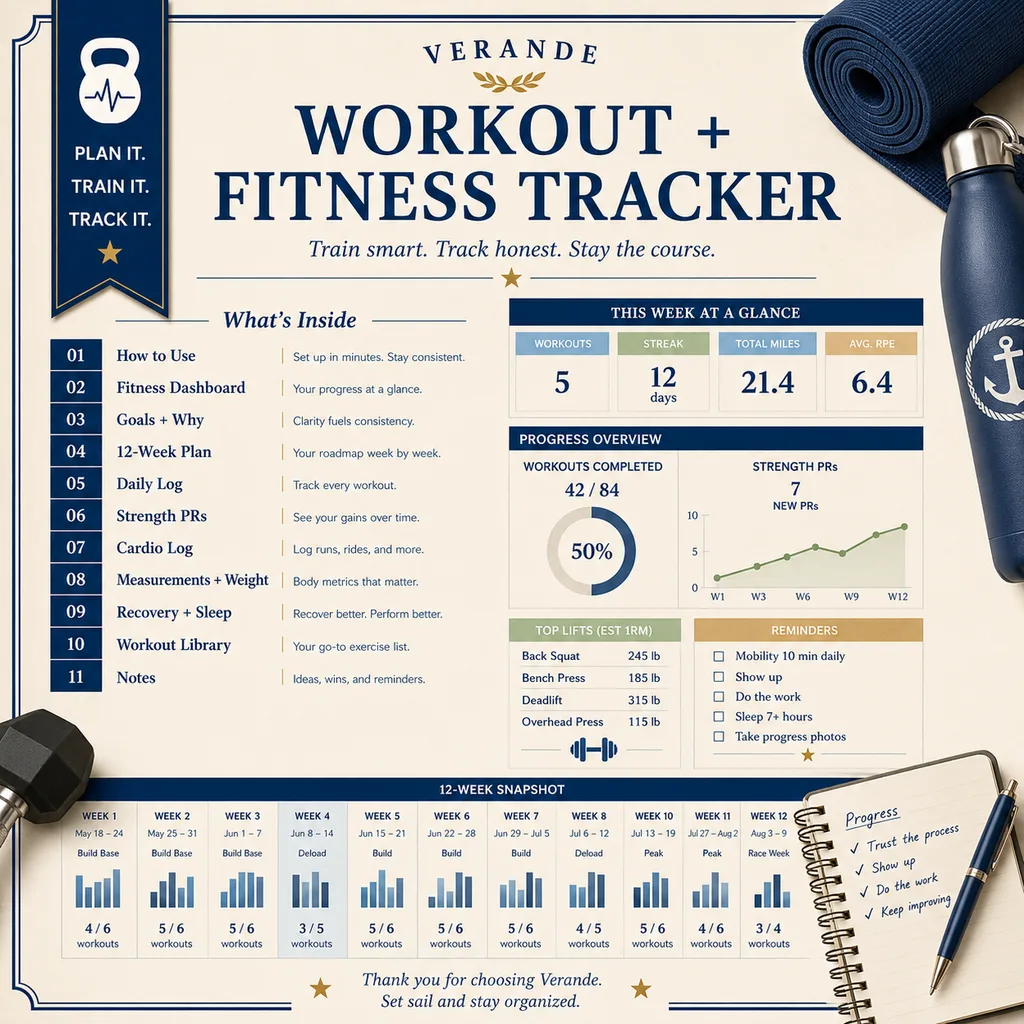
The Workout & Fitness Tracker is designed exactly this way, fast log entry, automatic volume calculation, week-over-week comparison on every lift. You open it on your phone between sets. You enter four numbers. You see whether last week's 165x6 is becoming 170x6 this week. The feedback is the motivation.
Train for something specific. "Get in shape" is not a goal.
The third failure mode is vague goals. "Get in shape," "lose weight," "be healthier", these aren't targets. They're moods. You can't train for them, you can't measure against them, and you can't tell when you've arrived. So you never arrive.
A real fitness goal has three properties:
- Specific, a number, a date, or a measurable performance
- Time-bound, a deadline that's far enough out to be possible and close enough to drive urgency
- Externally validated, something you do or hit, not just something you feel
Examples of real goals:
- Bench press 225 for one rep by November 1
- Run a half marathon under 1:55 on October 12
- Lose 22 pounds by August 30
- Do 20 strict pull-ups in a row by year end
- Complete a Murph in under 45 minutes by Memorial Day
These goals are trainable. You can build a program backward from them. You can tell, every week, whether you're on track. And you can tell, definitively, when you've succeeded.
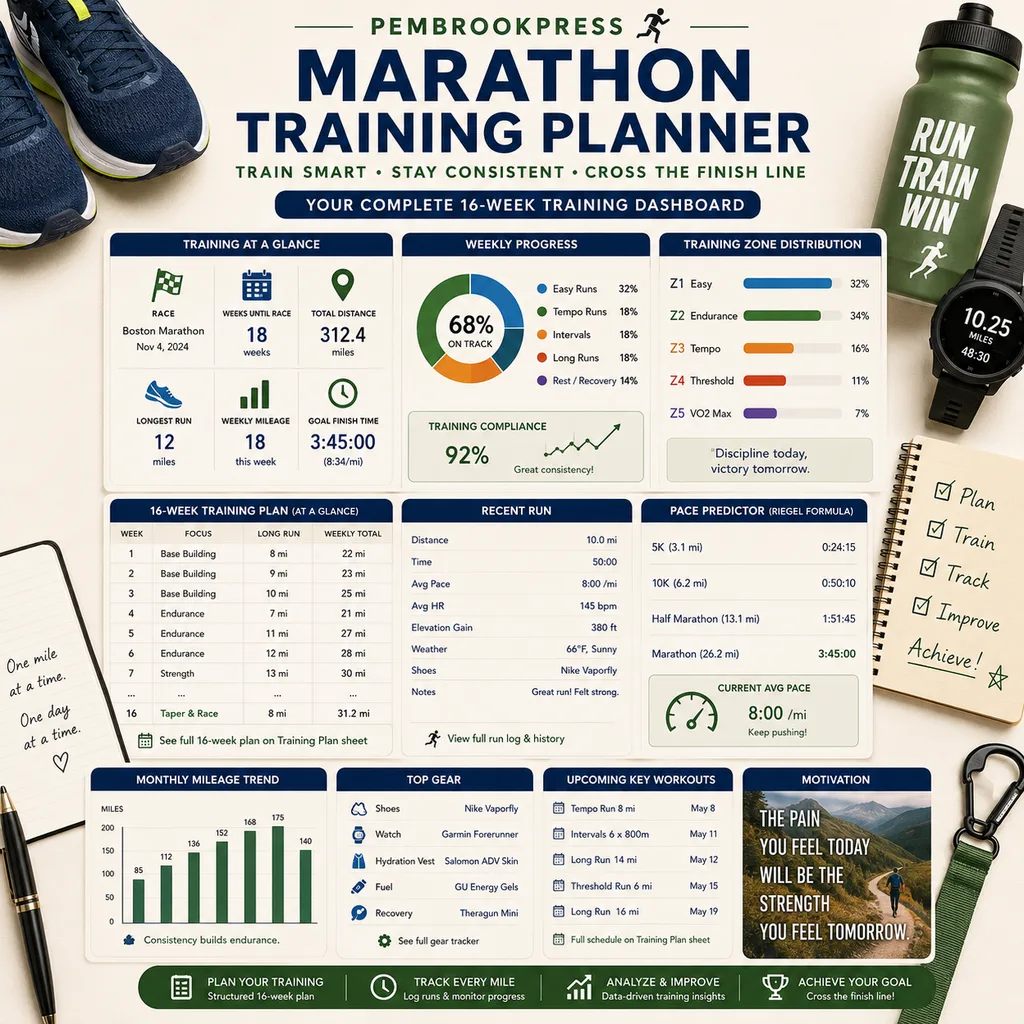
If your goal is a race, a 5K, a half, a full marathon, a triathlon, the program structure matters more than any other variable. You can't wing it. The Marathon Running Training Planner gives you a full periodized buildup, base, build, peak, taper, with weekly mileage targets, long run progression, recovery weeks built in, and a logging system that tracks every run against the plan. People who follow a structured plan and log every run finish their first marathon roughly 100 percent more often than people who "kind of train", that's not a typo, the dropout rate without a plan is brutal.
If your goal is strength, the same logic applies, pick a program, log every session, progress is the metric. The undertrained guy with a log beats the talented guy without one, every time.
Build the habit before you build the result
The honest truth about fitness: results take longer than your motivation will last. A real fat-loss arc is 12 to 24 weeks. A real strength arc is 6 to 18 months. A first marathon takes 4 to 6 months of build. Your motivation is good for about 21 days.
So you need to build the habit of training before you need the results from training. The habit is the load-bearing thing. The results follow it, eventually, almost automatically.
The mechanics of a habit that sticks:
- Schedule, not motivation. Workouts go on the calendar like meetings. You don't decide whether to go in the morning. The decision was made when you scheduled it. You just execute.
- Same time of day, mostly. Body clocks form. The 6am workout becomes auto-pilot in week three. The "fit it in whenever" approach stays effortful forever.
- A streak you protect, but a streak that allows misses. Aim for 4 sessions a week. If you miss one, you have three other days to make it up. A weekly target with daily flexibility outperforms a daily target every time.
- A trigger. Workout clothes laid out the night before. Gym bag in the car. Pre-workout coffee made at 5:45 sharp. The trigger does the lifting on the days motivation is gone.
The Habit Tracker is the layer underneath the fitness work. It tracks the boring foundations, workouts logged, water intake, sleep, protein, mobility work, whatever you're trying to build into autopilot. People who track habits hit their fitness goals at materially higher rates than people who just track outcomes, because the habit is the leading indicator that the outcome will follow.
Plan for the bad weeks. They're coming.
Every fitness journey has weeks that fall apart. Travel weeks. Sick weeks. Stressful work weeks. Family emergency weeks. If your plan can't absorb a bad week without you quitting, your plan is fragile.
The fix is a defined "minimum mode", what training looks like when life is on fire. For most people:
- Two strength sessions a week, 30 minutes each, just the main lifts
- One walk or easy cardio session, 20-30 minutes
- Sleep and food still get tracked, even if they're imperfect
- The streak doesn't reset. Minimum mode counts. You didn't miss; you adapted.
This is the difference between a fitness journey and a fitness yo-yo. The yo-yo person treats a missed week as failure and starts over (which is to say, never finishes). The journey person treats a missed week as data, drops to minimum mode, and resumes full training the next week. Twelve months later, the journey person is in a different body. The yo-yo person is on their third "fresh start" of the year.
Weigh-in honestly. Eat for the goal. Track the food, at least loosely.
If your goal is fat loss, the workout is the easy part. The food is the lever. You cannot out-train a 700-calorie daily surplus. You can out-train almost any reasonable food plan.
You don't have to count every almond. You do have to track loosely enough to know whether you're in a deficit. The simplest version:
- Weigh yourself every morning, same time, same conditions
- Average the weights weekly
- If the weekly average isn't trending down at 0.5 to 1.0 pounds per week, eat less or move more
- If it is, keep going
That's the whole game. Fancy macro splits, perfect meal timing, exotic supplements, none of it matters more than the basic "is the weekly average going down" question. Track that honestly for 12 weeks and you'll see results that two years of unstructured "trying" never produced.
Start this week. Pick one metric. Log one session.
Don't wait for January. Don't wait until Monday. Don't wait until you have the perfect plan. Pick the goal, pick the primary metric, schedule three workouts this week, and log them.
The Weight Loss & Fitness Goal Tracker is your control panel, goal, metric, weekly trend, dashboard. The Workout & Fitness Tracker is the training log that makes progressive overload non-negotiable. The Habit Tracker is the foundation underneath both.
You don't need a new program. You need a system that's still running in November. That's the only difference between the person who got in shape this year and the person who didn't.
Weight Loss Fitness Goal Tracker
Weekly weigh-ins, calorie and macro log, workout history, streak tracker, and a milestone tab, the whole effort, visible.